Overview
This article covers practical guidance for construction equipment use in Russia: market context, renting vs buying, machinery selection for each construction stage (foundation → roof → finishing), new-product trends and brief reviews, maintenance and winterization, regulatory and operator requirements, plus tips for integrating equipment into design and BIM workflows.
Market context (Russia)
— The Russian construction-equipment market is a mix of imported global brands (Caterpillar, Volvo, Liebherr, JCB, Komatsu) and increasingly competitive Chinese and domestic manufacturers (XCMG, SDLG, Chetra, Uralmash, etc.).
— Sanctions and logistics can affect spare-part availability and lead times — plan procurement and stock critical consumables.
— Demand is high for rentals in regions with seasonal peaks (spring thaw, summer construction) and for short-term specialized tasks.
— Digital features (telematics, 3D machine control) are increasingly expected for productivity and remote support.
Regulation and operator qualifications (key Russian specifics)
— Construction standards: adhere to national standards (ГОСТ) and current building codes (СП/СНиП where applicable) — these affect equipment use for lifting, scaffolding, and earthworks.
— Oversight and technical safety: Ростехнадзор and local authorities enforce rules for certain heavy equipment and lifting operations.
— Operator certification: machine operators must have appropriate certificates/permits (e.g., удостоверение тракториста-машиниста or equivalent) and workplace-specific safety briefings.
— Insurance and permits: ensure contract terms cover civil liability, equipment damage, and, when needed, road permits for oversized transport.
Equipment by construction phase: selection and application
1. Foundation and earthworks
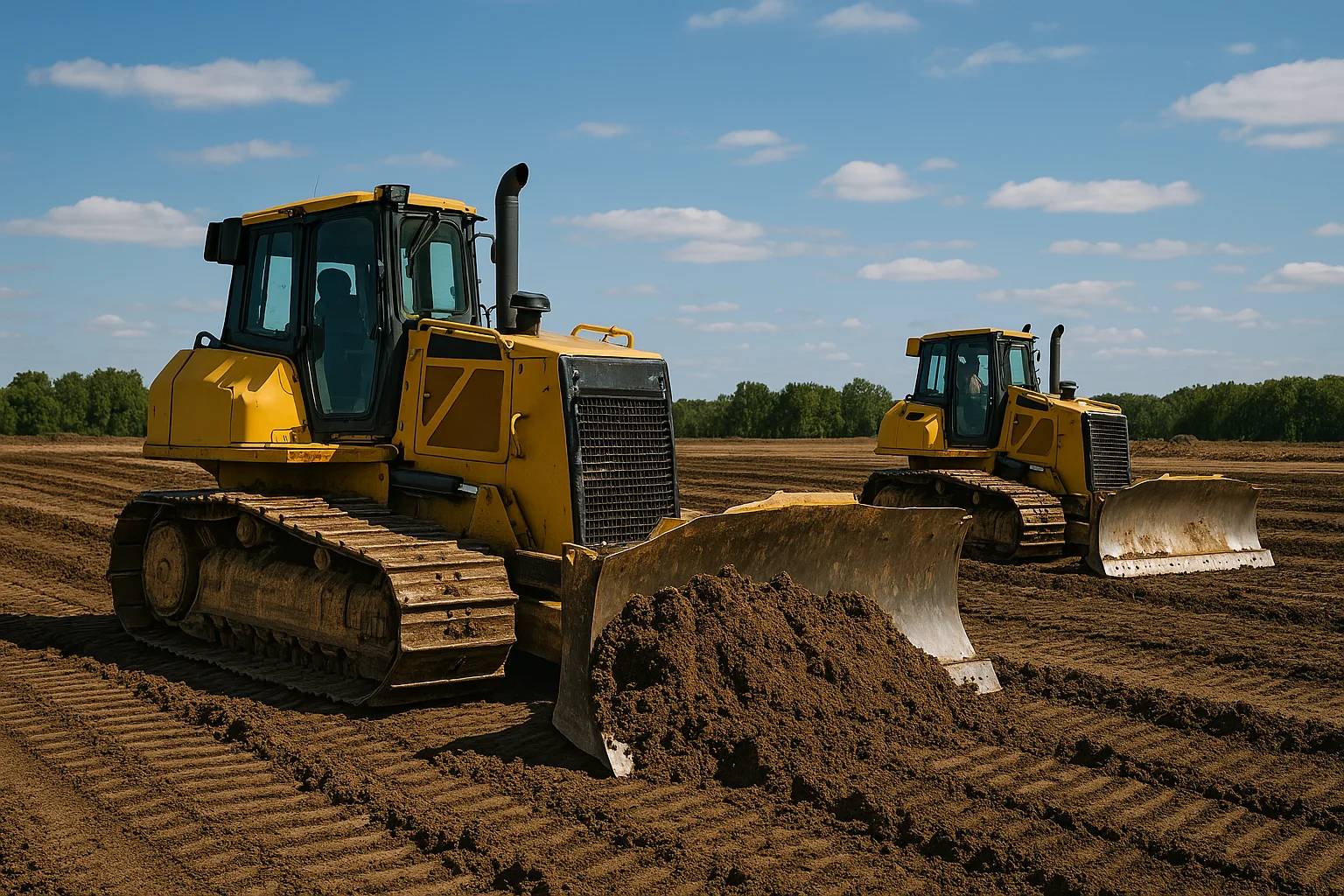
— Key machines: excavators (mini → heavy), backhoe loaders, bulldozers, skid-steer loaders, vibratory compactors, trench rollers, piling rigs.
— Considerations:
— Soil type and groundwater: choose machine size, hydraulic breaker vs. piling, and dewatering pumps accordingly.
— Precision grading: use GNSS/3D control systems for foundations and site leveling to reduce rework.
— Winter: heated cabs, cold-start kits, specific hydraulic/oil grades and battery heaters.
2. Structural work (frames, concrete)
— Key machines: tower/crane or mobile cranes, concrete pumps, boom pumps, mixers, lift platforms.
— Considerations:
— Lifting capacity + reach: calculate max load and safety margins per SP requirements.
— Concrete technology: choose pumps and mixers rated for local slump and aggregate size; account for hot/cold weather admixtures.
— Prefab assembly: use mobile cranes and telehandlers with load-sensing attachments.
3. Roofing and envelope
— Key machines: truck-mounted lifts, articulating boom lifts, scissor lifts, telehandlers, smaller cranes.
— Considerations:
— Access and working heights: select machines with safe working platforms and fall-protection setups.
— Facade panels and insulation handling: use vacuum lifters for glass/stone to reduce manual risk.
4. Utilities, finishing and landscaping
— Key machines: mini-excavators, compact loaders, trenchers, stump grinders, small cranes, compactors.
— Consider noise/emission limits for urban projects — electric or Stage V-compliant machines where applicable.
New-product trends & brief reviews
— Electrification and hybrid machines:
— Trend: electric mini-excavators, battery-powered telehandlers, and hybrid wheel loaders reduce onsite emissions and operating noise — useful in confined/urban jobs or indoors.
— Practical note: charging infrastructure and battery cold-weather performance need evaluation for Russian winter conditions.
— Telematics & remote diagnostics:
— Integrated telematics help monitor fuel, hours, location, and predictive maintenance — critical when parts are scarce.
— 3D machine control & automation:
— GNSS-based grading, site models linked to machines (Topcon, Leica, Trimble solutions) reduce operator error and speed foundation/grade work.
— Compact, multi-function attachments:
— Quick couplers, hydraulic breakers, grapples, and milling heads increase versatility of a single carrier.
— Chinese and localized models:
— Chinese OEMs (XCMG, SDLG, Zoomlion) offer cost-competitive machines with improved quality in recent years — evaluate aftersales and spare-part support.
Rentals — best practices in Russia
— When to rent:
— Short-term tasks, specialized equipment, peak seasons, or when capital expenditure is limited.
— Checklist before signing:
— Machine condition report with photos and hour-meter reading.
— Maintenance history and serviceability.
— Included attachments, spare tires/tracks, fuel policy.
— Transport logistics and responsibility for delivery/return.
— Insurance coverage, liability and deductible clauses.
— Cold-weather/winterization kit availability.
— Contract tips:
— Specify downtime penalties, repair responsibilities, and clearly define “wear and tear.”
— Request telematics access where possible to verify actual usage.
— Seasonal planning:
— Book critical machines ahead of spring and pre-winter to avoid shortages.
Purchasing new equipment — buying checklist
— Define total cost of ownership:
— Purchase price + financing/leasing, fuel, consumables, expected downtime, spare parts availability, resale value.
— Evaluate aftersales:
— Local dealer network, warranty terms, availability of certified service engineers.
— Trial/demo:
— Insist on a site demo under project conditions (soil, slope, temperature).
— Financing:
— Explore leasing and state-backed programs (local bank/leasing offerings) that may be available for construction businesses.
Maintenance, parts, and winterization
— Preventive maintenance:
— Follow manufacturer