Overview
The Russian construction market demands rugged, reliable equipment that performs in diverse climates and on a wide range of projects—from urban infill to large infrastructure and remote industrial sites. This guide covers equipment rental vs purchase, choosing new machines, hands-on applications from foundation to roof, design and site-integration assistance, plus practical tips for working in Russia’s regulatory and climatic environment.
Quick Snapshot: What Russian contractors need to know
— Climate matters: winterization, cold-start systems, oil and fuel specifications are essential.
— Support network: choose brands with local dealer networks and spare-parts availability.
— Flexibility: rental market is strong for short-term or specialized needs; purchase makes sense for high-utilization fleets.
— Compliance: follow local building codes (SNiP), GOST standards and transport/customs rules when importing equipment.
Rental vs Purchase: Decision Framework
Consider these factors when deciding whether to rent or buy:
— Project length and frequency
— Short-term or infrequent projects → Rent
— Continuous, long-term operations → Buy
— Utilization and cost
— High utilization (>1,200–1,500 hours/year) and predictable work → Purchase (better TCO)
— Low to medium utilization → Rental or lease
— Capital and balance sheet impact
— Limited capex or need for fleet flexibility → Rental/lease
— Strong capex and need for customization → Purchase
— Maintenance and logistics
— No in-house service capability → Rental with service included
— In-house technicians and storage → Buy
Equipment by Phase: Foundation to Roof
— Site preparation and earthworks
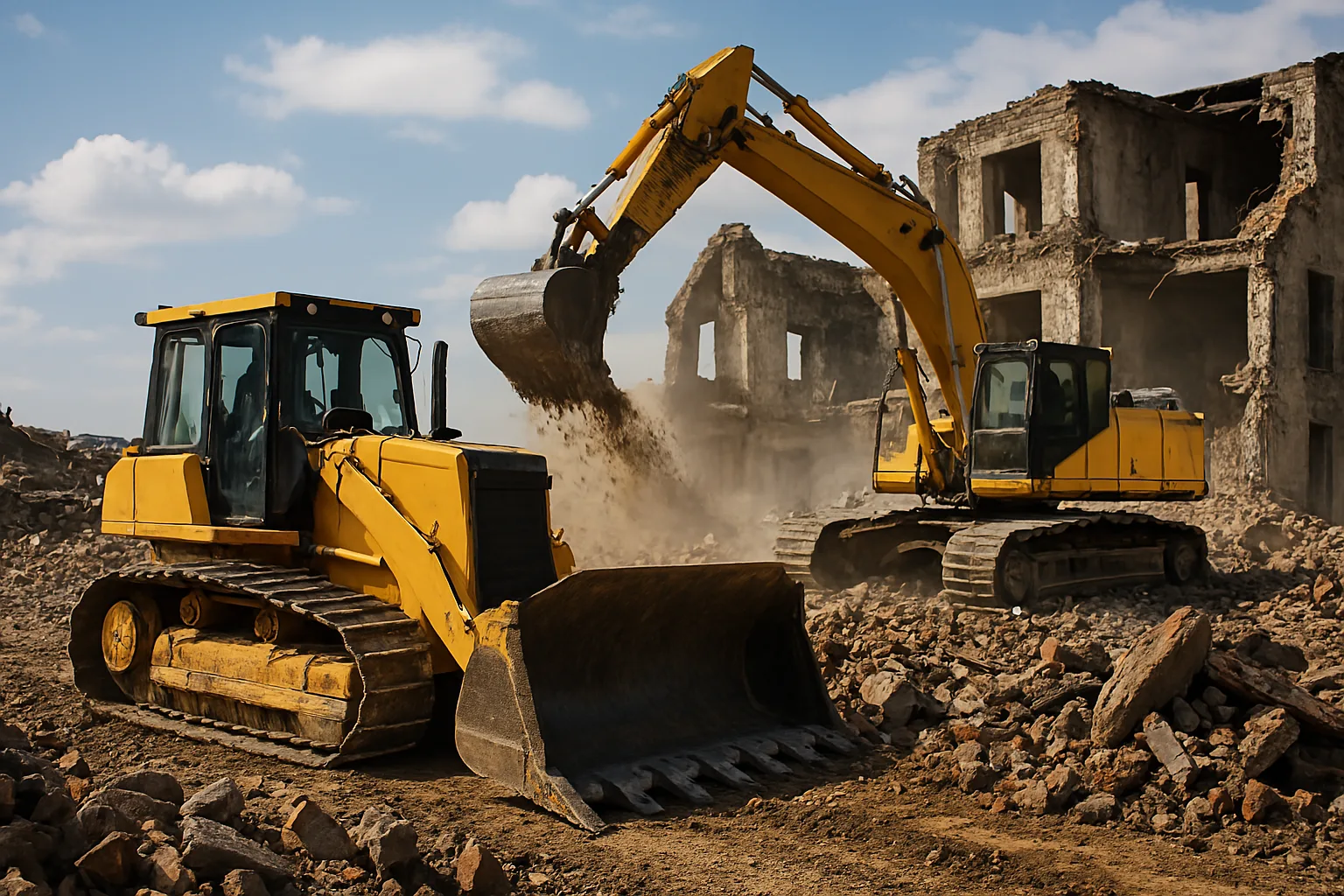
— Bulldozers, tracked/wheeled excavators, graders, skid-steers
— Key uses: clearing, bulk cut-and-fill, trenching, rough grading
— Foundation and piling
— Piling rigs, CFA rigs, rotary drilling rigs, hydraulic hammers, sheet-pile vibrators
— Concrete pumps and batching plants for continuous pours
— Underground utilities and dewatering
— Trenchers, horizontal directional drilling (HDD) rigs, submersible pumps, vacuum excavators
— Structural works and superstructure
— Tower cranes, mobile cranes, telescopic handlers, forklifts
— Concrete mixers, placing booms, formwork accessories
— Facade and envelope
— Mast climbers, mobile elevating work platforms (MEWPs), swing stages, scaffolding systems
— Roofing and insulation
— Mobile cranes, rooftop hoists, heat guns, roof-cutting tools, compressors for insulation installation
— Finishing and MEP works
— Aerial work platforms, compact loaders, mini-excavators for landscaping, portable generators, air compressors
— Roadworks and surfacing
— Asphalt pavers, compactors/rollers, milling machines, cold-planers
— Recycling and demolition
— Mobile crushers, hydraulic breakers, shears, sorting conveyors
Product Review Criteria (what to look for when testing or buying)
— Availability of local service and spare parts
— Total cost of ownership (fuel, maintenance, resale)
— Telemetry and diagnostics (remote monitoring)
— Operator comfort and ergonomics (for productivity in long shifts)
— Cold-start and winter operation features
— Compatibility of attachments and quick couplers
— Emissions and compliance with local environmental requirements
Popular Brands and Local Considerations
— Global OEMs commonly used in Russia: Caterpillar, Komatsu, Liebherr, Volvo, JCB, Hitachi.
— Chinese manufacturers (XCMG, SDLG) have growing presence due to competitive pricing and expanding dealer networks.
— When selecting brands in Russia, prioritize dealers with: service centers, certified technicians, genuine-parts stock, and warranty handling.
Winter and Harsh-Climate Preparation
— Engine block heaters, battery warmers, fuel conditioning systems and winter-grade diesel.
— Use hydraulic oils and greases rated for low temperatures.
— Anti-freeze and coolant systems sized for extreme low temps.
— Warm storage, canned pre-start procedures and planned maintenance intervals adjusted for cold operation.
Safety, Training and Compliance
— Ensure operators hold required certifications and training (company-managed training or accredited centers).
— Follow SNiP and GOST where applicable; confirm equipment load charts and lifting plans for cranes.
— Insure machinery and check transport permits for oversized loads.
— Implement site-specific safety plans and daily checks (before-shift inspections).
Maintenance Best Practices
— Establish preventive maintenance schedules tied to operating hours, not just calendar time.
— Keep records: service logs, parts replaced, telematics reports.
— Stock critical spare parts (filters, belts, seals) locally.
— Use authorized service centers for major repairs to preserve warranties and resale value.
Used Equipment: Buying Tips
— Inspect service history and hours; request maintenance records.
— Conduct a full mechanical and structural inspection (hydraulics, frame, pins, boom).
— Use independent inspection services or request a test under load.
— Consider buying from certified refurbishers or OEM-certified used programs.
Design Assistance and Digital Tools
— Integrate equipment selection early in design: crane reach, delivery routes, staging areas, lifting plans.
— Use BIM to simulate construction sequences and equipment clashes.
— Leverage telematics and fleet-management software to plan machine allocation and reduce idle time.
— Collaborate with equipment suppliers on site logistics and sequencing to optimize productivity.