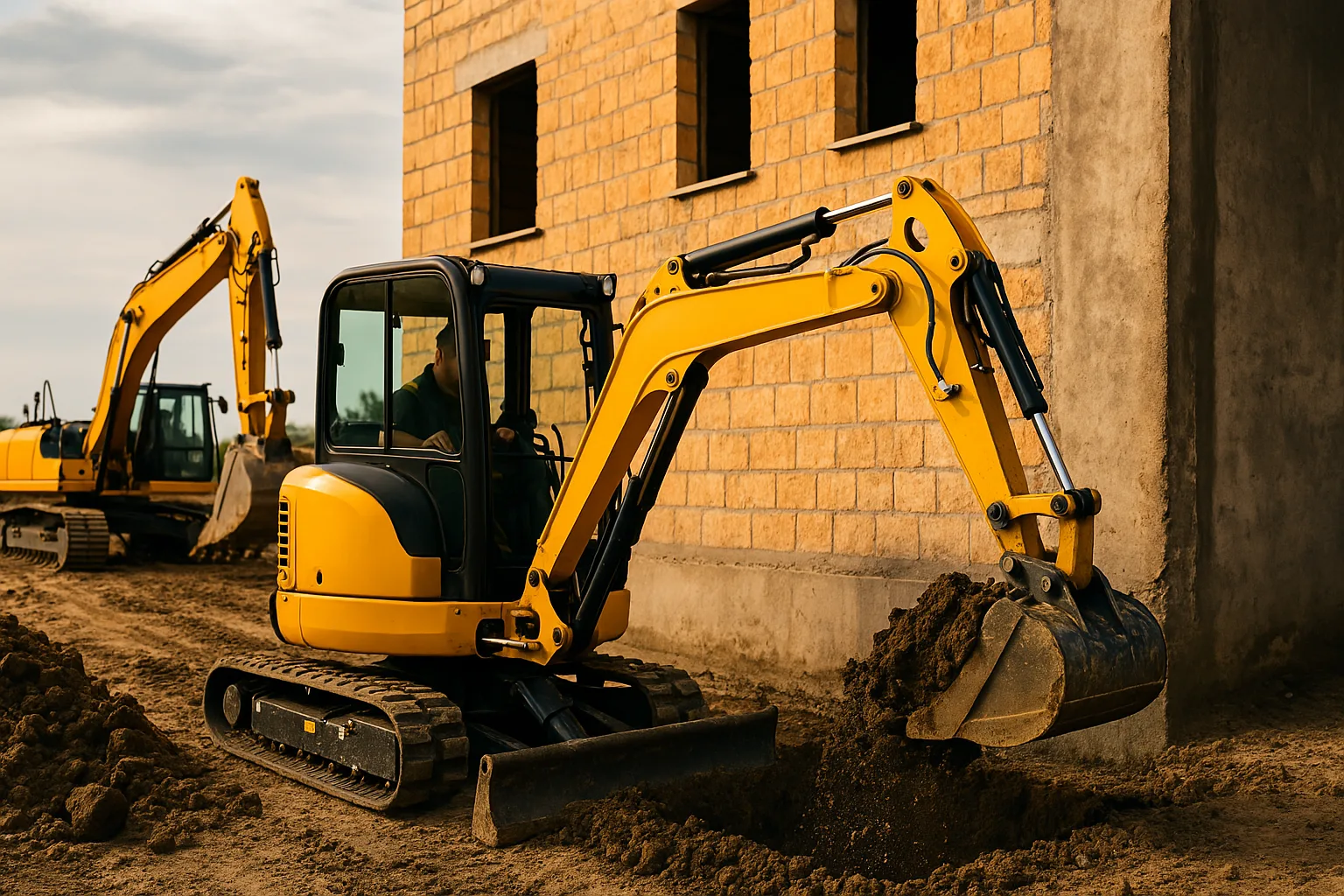
Introduction
The Russian construction market demands durable, versatile equipment—from heavy earthmoving machines on infrastructure projects to compact units for tight urban sites. This guide covers rentals vs. purchases, how to evaluate new products, equipment applications at every construction stage, design and planning support, procurement and maintenance considerations, and practical tips for working in Russia.
Market snapshot (Russia)
— Demand drivers: housing programs, transport infrastructure, industrial projects, and regional development.
— Supply dynamics: international brands (Liebherr, Volvo, Caterpillar, Komatsu, JCB, Hitachi) remain influential, while domestic manufacturers and local distributors fill gaps in parts and service.
— Trends: electrification and hybrid drives for urban works, telematics and remote diagnostics, growing used-equipment trade, and emphasis on fuel efficiency and uptime.
Rent vs. buy: how to decide
Consider these factors when choosing rental or purchase:
— Project duration: rent for short-term or seasonal needs; buy for long-term, high-utilization assets.
— Cash flow and financing: rentals preserve capital; buying requires financing but can be cheaper per hour over years.
— Availability of service and parts: if local service is weak, owning may be risky.
— Equipment specialization: rare or highly specialized machines are often rented.
— Residual value and depreciation: used-equipment market in Russia is active—factor resale.
What to expect from rental providers
— Typical offerings: daily/weekly/monthly rates, operator-included options, transport/delivery, fuel or fuel surcharge, attachments and accessories.
— Contracts: clearly define liability, damage thresholds, downtime policy, and maintenance responsibilities.
— Inspection: demand pre-handover condition reports, hours/cycle counters, and valid paperwork (registration, service log).
New-product review guide: what matters when evaluating new machines
Rather than specific models, prioritize these attributes:
— Productivity and fuel efficiency: cycle times, flow-sharing hydraulics, and engine consumption.
— Telemetry and diagnostics: remote monitoring reduces downtime.
— Operator comfort and ergonomics: controls, visibility, and climate systems increase productivity.
— Serviceability: access to filters, oil drains, diagnostic ports, and parts availability in Russia.
— Emissions and compliance: meet local norms and duty/clearance requirements.
— Attachment ecosystem: compatible buckets, breakers, grapples.
— Total cost of ownership (TCO): purchase price plus fuel, maintenance, parts, and resale expectations.
Emerging product categories to watch:
— Electric and hybrid mini-excavators and loaders — ideal for indoor and urban jobsites (near-silent, zero local emissions).
— High-capacity mobile and crawler cranes with computerized lift planning.
— Advanced concrete pumps with remote controls and optimized boom geometry.
— Autonomous or semi-autonomous site machines (grading and compaction) with guidance systems.
Equipment by construction stage: from foundation to roof
Foundation and groundworks
— Key machines: hydraulic and rotary piling rigs, CFA rigs, drilling rigs, crawler excavators, bulldozers, trenchers, vibratory hammers.
— Applications: deep foundations, bored piles, driven piles, sheet piling, site stripping, trench excavation, dewatering pumps.
— Tips: plan lifting and access early; coordinate piling rigs with pile-driving mats and crane positions for safety.
Substructure and structure (frames and shells)
— Key machines: tower cranes, mobile cranes, concrete pumps, telehandlers, tower hoists, high-capacity excavators, compactors.
— Applications: concrete pours, precast handling, steel erection, heavy lifting, backfilling.
— Tips: crane-lift plans and route checks are critical—use qualified lift planners and ensure compliance with load charts and local standards.
Envelope and façade
— Key machines: aerial work platforms (booms and scissor lifts), suspended platforms, mast-climbing work platforms (MCP), façade cranes.
— Applications: glazing, cladding, insulation, curtain-wall installation.
— Tips: choose equipment to match façade height and overhang; factor wind limits and anchorage points.
Roofing and top works
— Key machines: compact cranes, boom lifts, roof hoists, material lifts, small loaders for rooftop works.
— Applications: roof decks, membrane installation, solar panel deployment, parapet work.
— Tips: consider lightweight lifts to minimize roof loading; comply with fall-protection regulations.
Finishing and interiors
— Key machines: skid-steer loaders, mini-excavators, floor grinders/polishers, industrial vacuum units, small material handlers.
— Applications: floor leveling, MEP routing trenches, interior demolition, logistics of finishes.
— Tips: prioritize low-emission and low-noise equipment in occupied urban settings.
Roadworks and landscaping
— Key machines: pavers, milling machines, rollers, asphalt distributors, graders, compact excavators.
— Applications: road resurfacing, new carriageways, curb and drainage installation.
— Tips: integrate thermal