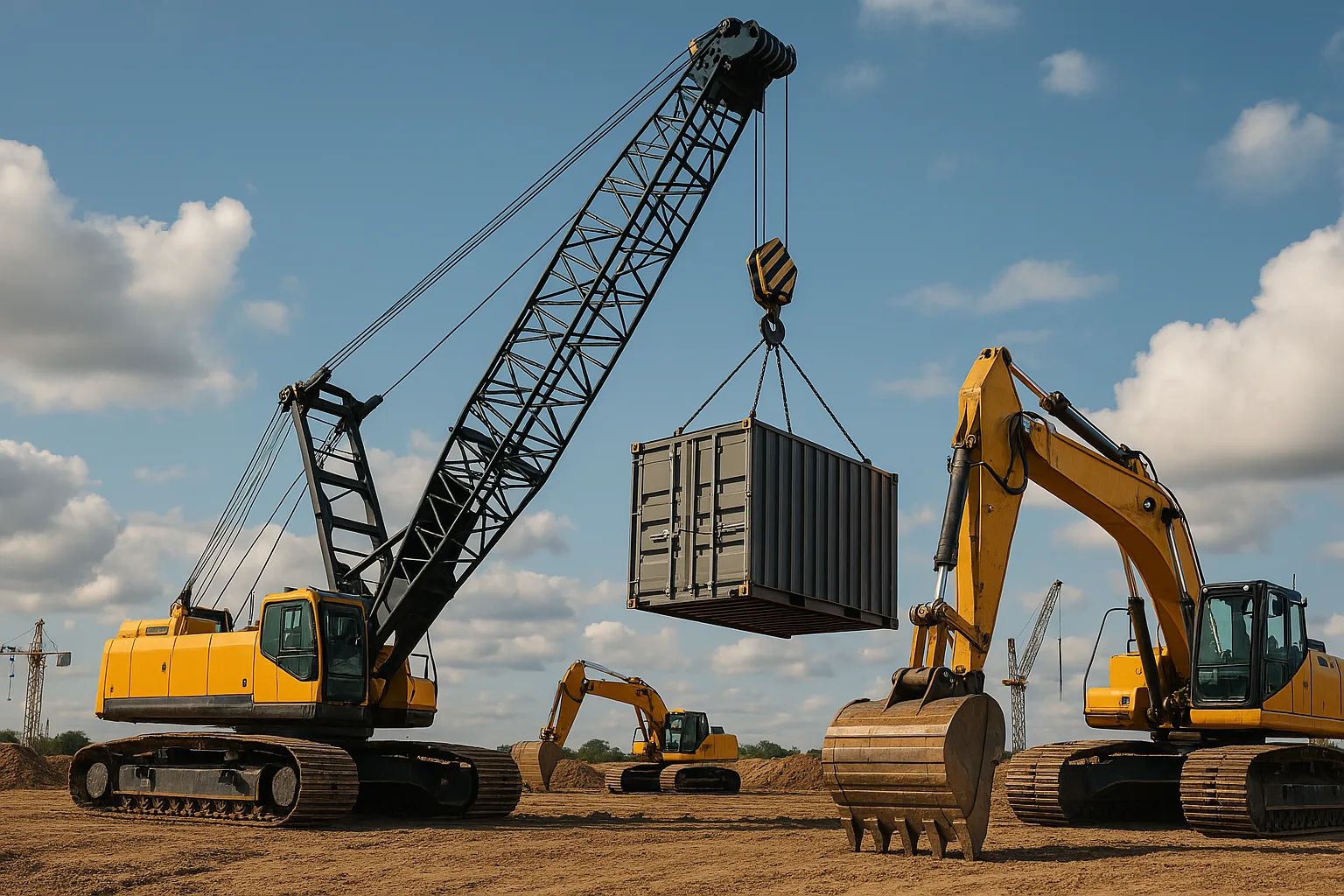
Overview
Russia’s construction-equipment market blends global brands, Chinese manufacturers, and domestic heavy-equipment producers. Projects range from urban infill and apartment construction in Moscow and St. Petersburg to large-scale infrastructure in Siberia and the Far East. Key local considerations: long transport distances, extreme seasonal temperature swings, and compliance with Russian construction norms and standards (СНиП / СП, ГОСТ), plus occupational-safety rules.
This guide covers rentals, evaluating new machines, applications across all building stages (foundation to roof), design-assistance integration, and practical procurement/maintenance tips tailored to Russia.
Rentals: when to rent, how to choose, and winter considerations
Why rent
— Short-term needs, pilot projects, or peak-season capacity surges.
— Try equipment types before capital purchase.
— Avoid depot and long-term maintenance overhead.
Rental types and services
— Dry hire (machine only), operator + machine, full-service (transport, fuel, maintenance).
— Typical rental durations: daily, monthly, contract (6–12 months).
— Local rental hubs: major cities and regional centers — request guaranteed transport times and winter prep.
What to insist on in the rental contract
— Exact make/model, hour meter reading on delivery, fuel level, attachments included.
— Insurance, liability allocation, and responsibility for breakdowns.
— Transport and mobilization/demobilization terms and costs.
— Operator certification requirements (if operator provided) and site-specific safety briefings.
— Penalties for late return or meter tampering.
Winterization and cold-climate needs
— Engine block heaters, battery warmers, winter-grade oils/hydraulics, antifreeze rated for local temps.
— Pre-start procedures and warm-up time allowances.
— Trailers/trucks with adequate insulation for transport.
On-delivery inspection checklist
— Visual damage, hydraulic leaks, tire/track condition, fluid levels, bucket/attachment wear.
— Operational test of hydraulics, brakes, lights, instrumentation.
— Photograph serial/ID plates and hour meter.
New-product reviews — what matters when evaluating machines
Core evaluation criteria
— Productivity: breakout force, bucket capacity, cycle times.
— Fuel efficiency and real-world consumption.
— Reliability and ease of repair: modular components, service access.
— Dealer/service network and spare-parts availability in Russia.
— Operator comfort and ergonomics (important in extreme climates).
— Telematics and diagnostics (remote fault codes, hours, fuel use).
— Resale value and total cost of ownership (TCO).
How to run a practical field test
— Benchmark a day or two under typical site conditions (soil type, slope).
— Compare machines doing the same task and measure fuel, cycle times, and operator feedback.
— Test cold starts and hydraulic responsiveness in low temperatures.
— Confirm diagnostics feed to local dealer/service portal.
Brands and sourcing notes
— Global OEMs (Caterpillar, Volvo, Liebherr, Komatsu, JCB) have strong product lines but spare-part lead times can vary by region.
— Chinese manufacturers (XCMG, Zoomlion, Sany, Lonking) offer competitive pricing and rapid market penetration; check warranty and local service partners.
— Domestic heavy-equipment producers and retrofitters supply tractors, dump trucks, and specialized equipment in certain niches—useful for heavy Russian climates and local parts supply.
Equipment by construction stage: foundation to roof
Site preparation & earthworks
— Excavators (mini to large): trenching, foundation pits.
— Bulldozers & graders: leveling, roadbeds.
— Rollers/compactors: soil compaction, embankments.
— Trenchers and rock-breakers for utilities.
Foundations
— Piling rigs (rotary, CFA), pile drivers — ensure rig capacity matches pile type.
— Concrete mixers (mobile and stationary) and batching plants.
— Concrete pumps (boom and line) and vibrators for consolidation.
— Soil stabilization equipment (cement mixers, jet grouting rigs).
Structure (frame & envelope)
— Crawler cranes and mobile cranes for lifting structural elements.
— Telehandlers and forklifts for material handling on site.
— Tower cranes for multi-storey projects.
— Scaffolding, mast-climbers, and construction hoists for façade work.
Roofing & exterior finishes
— Aerial platforms (cherry pickers), boom lifts for roof access.
— Roofing machines for large industrial roofs (if applicable).
— Asphalt pavers, road rollers for site access and parking areas